


Hey, I’m Pastor Chris. I write honest, hope-filled articles for people trying to follow Jesus through real life — the kind with questions, setbacks, and suffering. If that’s you, you’re in the right place. Consider subscribing to stay connected and help support this work.
It seems like the atom bomb that ends conversations—just waiting to go off, especially when someone wants to make an example of you. Since starting this newsletter, I’ve interacted with my fair share of people who subscribe (see what I did there?) to another line of thinking.
Perhaps we shy away from answering these questions because we don’t really want to know the answer. Maybe we’re afraid of what we’ll find when we lift the rug to see what the 2-year-old left behind.
So, what is the answer to the question: If God is good, why is there so much suffering?
We’ve all heard questions like:
If God is so loving, why do kids get cancer?
Why didn’t God stop the war, the abuse, the injustice?
How can you worship a God who lets bad things happen to good people?
It’s important to remember: these aren’t new questions. But they’re usually not real questions either. They’re daggers dressed up as dialogue. And they come from pain. Or pride. Or both.
So let’s not dodge them.
Let’s walk straight in.
The Real Problem Isn’t Pain — It’s Control
One night after a long day at work, I got home, went to bed, and was awakened to a knock at the door at 2:00 AM. It was a co-worker telling me that my best friend’s mother had passed.
I remember my body just moving. Getting dressed and climbing into the backseat of their minivan as we drove to my friend’s house to be with them while they sorted through the emotions of losing their last parent.
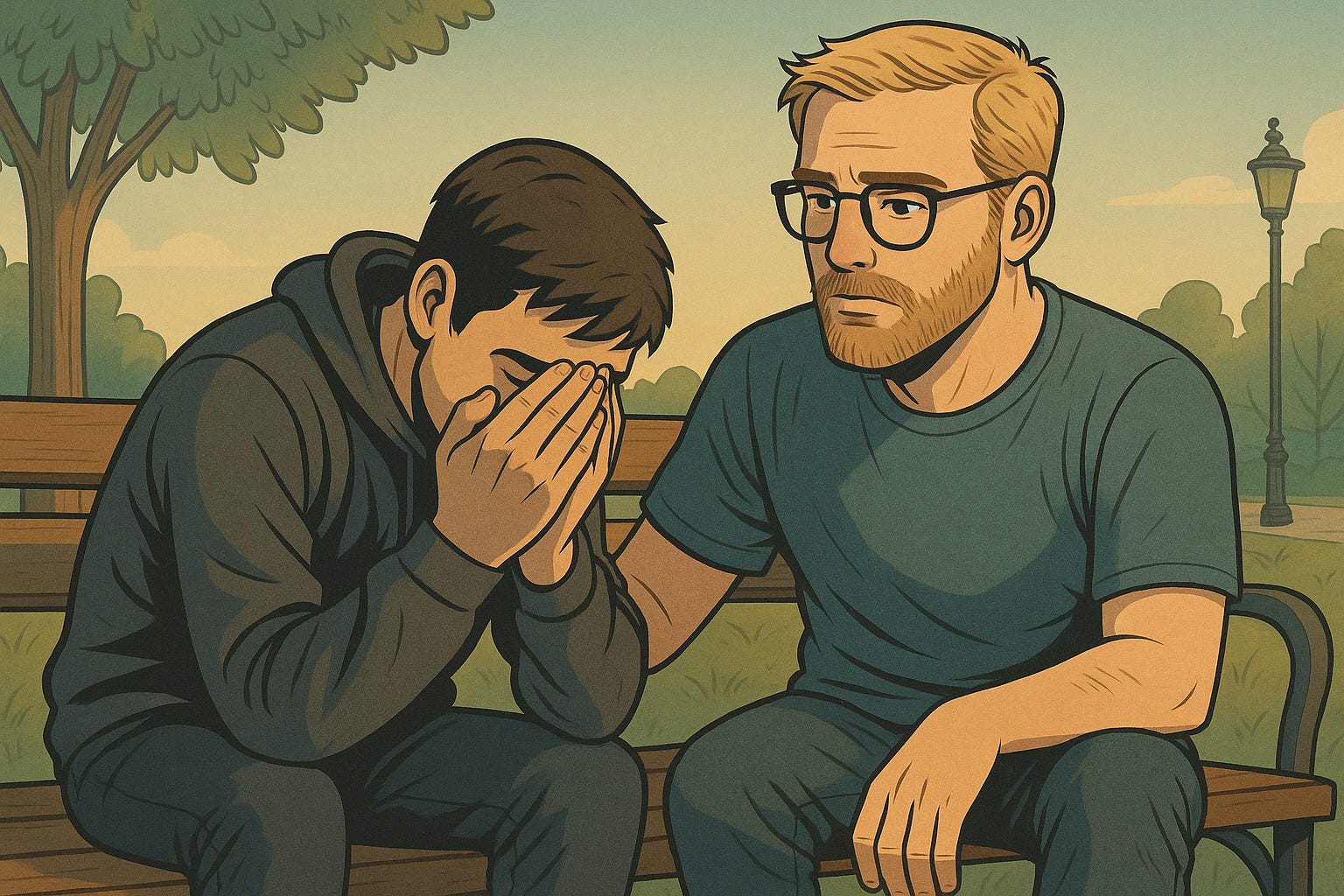
It wasn’t expected—an avalanche of emotions, unanswered questions, and unexpected details to attend to. I remember having nothing to say because, for me, I hadn’t suffered a loss like that. The only thing I knew to do was be there. I wasn’t there to solve any problems—just care.
It’s natural to want to take the pain away in those moments.
Life has taught me that I can’t do that - because it’s not up to me.
I can’t bring back a loved one who has passed, I can’t repair a marriage that is beyond the breaking point, I can’t make wayward children come home. What I can do is be the hands and feet of Jesus.
Most people aren’t mad that suffering exists.
They’re mad they can’t stop it.
They want a world where:
Evil is punished immediately
Pain is prevented instantly
And no one, ever, gets to hurt the innocent
And deep down, they want to be the judge of who qualifies as innocent.
But here’s the issue: if God removed all evil right now, He’d have to remove all of it.
That includes yours and mine.
The Bible Doesn’t Ignore Suffering
Many examples in scripture depict suffering that many of us are not accustomed to. We all want to ignore the suffering. But God doesn’t. He also doesn’t sugarcoat it either.
Job lost everything.
David cried until he couldn’t breathe.
Paul was beaten, shipwrecked, starved, and left for dead.
Jesus? He was tortured and nailed to a wooden cross — on purpose.
God doesn’t sidestep pain. He enters it. And then He redeems it.
“For this light momentary affliction is preparing for us an eternal weight of glory beyond all comparison.” (2 Corinthians 4:17)
Read that again: preparing for us.
Not random. Not wasted. Not pointless.
When Pain Doesn’t Make Sense: The Man Born Blind
In John 9, Jesus and His disciples walked past a man who had been blind from birth. The first question out of their mouths wasn’t compassionate. It was theological.
“Rabbi, who sinned, this man or his parents, that he was born blind?” (John 9:2)
Translation: Whose fault is this?
When suffering hits, we ask the same thing: We want cause and effect, logic, blame, and resolution. But Jesus doesn’t play that game and responds.
“It was not that this man sinned, or his parents, but that the works of God might be displayed in him.” (John 9:3)
That man sat in darkness his entire life, not because God was cruel, but because God was preparing a miracle.
Not a punishment. A platform.
Jesus healed him. Right there. Right then. With mud and spit and mercy.
That healing sent shockwaves through the whole community. Some believed, some argued, and some tried to cancel the miracle entirely.
But no one walked away unaffected.
It all started with a man who suffered for decades so God’s glory could break through the darkness.
But What About the Children?
Let’s be blunt.
If you’re using the image of a starving child as a prop to argue online, you’ve already lost the moral high ground.
If I were standing in front of that child, I wouldn’t post theological quips.
I would feed him.
Pain isn’t a philosophical puzzle. It’s a call to action.
If suffering breaks your heart. Good. It should.
Now do something about it.
God does.
But What About When God Causes Suffering?
This is the one that gets people angry.
“If your God is so good, why did He destroy entire cities — including women and children — like in Sodom and Gomorrah?”
It’s a heavy question. And it deserved something more than a reel.
Let’s get uncomfortable for a second.
Yes, God did judge those cities. He warned them, sent angels, and even offered to spare everyone if just ten righteous people could be found (Genesis 18:32). But there weren’t ten—not even close.
And when judgment came, it was devastating.
Children died.
That’s not something we minimize. But it’s also not something we get to rewrite.
If That Offends You — It Should
It should disturb you. Death is awful. Judgment is real.
And none of us — none of us — get to stand before a holy God and demand He play by our rules.
But here’s what we forget in the outrage: God is more heartbroken over sin than we are.
He sees the long-term damage we can’t.
He sees the generations of abuse, corruption, and destruction coming from hearts rejecting Him entirely.
You and I see the moment.
He sees eternity.
And when judgment comes, it is never without warning.
Never without mercy extended.
Never without justice served.
Do We Really Want a God Who Doesn’t Judge?
If God never judged evil — if He just let everything slide — He’d be a passive, spineless spectator.
We wouldn’t trust a human judge who let child traffickers go free.
So why demand that from the Judge of all the earth?
The death of a child is always tragic.
But the bigger tragedy is when we use their pain to shield ourselves from God’s authority.
“Will not the Judge of all the earth do what is just?” (Genesis 18:25)
Yes. He will.
Even if we don’t understand all of it yet.
You Want a God Who Fixes Things?
He already started.
He fixed the root of all suffering — the sin that fractured everything — through Jesus.
But He didn’t promise comfort now.
He promised redemption later.
“He will wipe away every tear from their eyes… neither shall there be mourning, nor crying, nor pain anymore.” (Revelation 21:4)
That’s where it’s headed.
But we’re not there yet.
We’re in the middle of the story.
So was the man born blind.
So are you.
A Wound or a Weapon?
Suffering can be a wound that festers. Or a weapon that awakens. You get to choose how you carry it.
But know, Jesus suffered too. He chose it. Not because He had to, but because we needed it.
You’re not alone in your pain.
And you’re not forgotten.
Let’s Keep Talking
If this stirred something in you, don’t just scroll past it.
🗣️ Leave a comment — Have you walked through a season of suffering or questioned where God was in the pain? I’d love to hear your story.
📤 Share this post — Someone in your world is carrying quiet pain. This might be the reminder they need that they’re not alone.
📬 Subscribe (free or paid) — I write for people wrestling with hard questions and holding on to hope. If that’s you, welcome. You’re not alone here.
Let’s walk this out together.
So good, Chris. I have struggled with this many times in the 2 years since my husband was killed. But through it all I have felt something that cannot be aptly described except to say that in the agony, there is something else that has been happening. Something sacred and profound. Maybe some would call it sanctification. It is palpable. And again, indescribable. There IS a point and a work to suffering. Which brings up more questions than answers. I think we have forgotten the mystery of God and the human experience. Without acknowledgement of that, nothing makes sense. I’ll never have answers but I trust in God’s sovereignty. If that’s all I have, I have it all.
This is was an amazing piece. It hit home hard. I've heard people ask these questions before but I've never really addressed them myself. Having lost my mom two months ago, just this April, I have definitely been through pain, struggle confusion and now just tiredness of it all. But I thank God for Him and this piece. It was easy to read and understand how to look at everything and God’s hand in it all 😊