


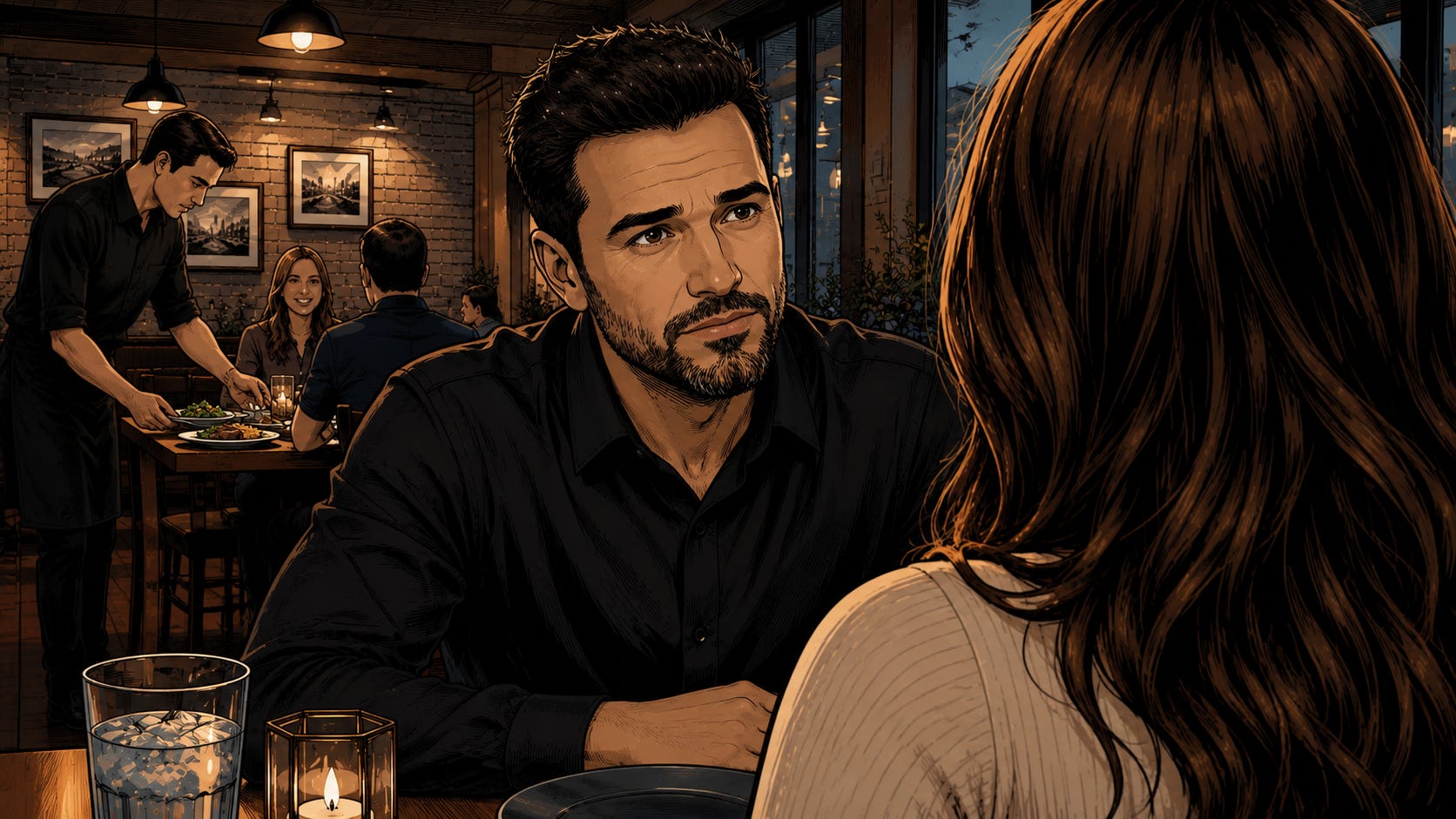
It was a long day at the church and we didn’t want to cook. After spending probably a little too long deciding where we wanted to eat, my wife and I made our way to a restaurant nearby. We walked in, sat down, ordered our food, and for the first twenty minutes I didn’t think anything about it. I was talking with my wife, our drinks were still full, and we ordered an appetizer so we had something on the table to enjoy while we waited.
Then I noticed that the people who sat down after us got their food.
I looked at their table, then at ours. I tried not to make a big deal about it, but now I was paying attention to the kitchen door. It swung open and a server walked out carrying two plates. For a second, I was sure they were ours. I straightened up a little, moved my phone out of the way, and watched the server make their way across the restaurant.
Then they turned toward another table.
By this point, I was hungry enough that whatever they ordered looked amazing.
A few minutes later, the kitchen door opened again and I did the same thing. This time the server walked right past us and set the food down at the table behind me. At some point, the conversation between my wife and me changed. One of us finally asked, “Did they forget about us?” I looked at the time and tried to remember exactly when we ordered. Then I started looking around for our server without wanting to look like I was looking around for our server.
Every time they walked past, I tried to make eye contact.
I started wondering if our order had ever made it to the kitchen. Maybe the ticket got lost. Maybe somebody forgot to put it in. Maybe our food had been sitting under a heat lamp for the last fifteen minutes while everyone assumed someone else had brought it out. The longer I sat there with nothing in front of me, the easier it became to believe that nothing was happening.
But there was one problem with that assumption. I couldn’t see the kitchen.
There could have been a cook standing over our food at that very moment. Someone could have been plating it. Maybe something came out wrong and they decided to remake it instead of serving it to us. There could have been an entire room full of people working on the very thing I was becoming convinced everyone had forgotten about.
From where I was sitting, I couldn’t see any of that.
All I could see was an empty table.
I think waiting on God can feel a lot like sitting at that table. I pray about something. I ask God for direction. I seek wise counsel, make the phone call, fill out the application, have the conversation, and do everything I know how to do. Eventually, I reach the point where there is nothing left for me to do except wait.
That’s where waiting becomes difficult for people like me. I like movement. I like fixing things. Give me a problem and I will probably start building a plan before you have finished explaining it. At least when I’m doing something, I can convince myself that I’m moving forward.
Waiting takes that away from me.
Eventually, I start doing with God exactly what I did in that restaurant. I start looking around for some indication that He hasn’t forgotten about me. Did I misunderstand Him? Did I do something wrong? Is this a closed door? Should I be doing something else? How long am I supposed to sit here?
The longer nothing seems to happen, the easier it becomes for me to interpret what I can see as evidence of what God is doing.
But I’m sitting at the table.
I can’t see the kitchen.
And I wonder how many times I have mistaken my inability to see what God is doing for evidence that God isn’t doing anything.
Joseph could not see what God was doing either.
A Prison in Egypt
We have an advantage over Joseph that Joseph never had. We know how his story ends.
We know that Pharaoh will have a dream. We know that a cupbearer will be imprisoned, restored to the palace, and eventually remember Joseph’s name. We know that Joseph will leave prison and stand before the most powerful man in Egypt. He will interpret Pharaoh’s dreams and be entrusted with enormous responsibility and authority. We know that famine is coming and that the young man sitting in an Egyptian prison will eventually become part of God’s provision for an entire region, including the brothers who once sold him.
Knowing the ending makes the middle much easier to read.
Joseph did not have that luxury.
By the time we find him in Genesis 40, his life had already taken several turns that would have been difficult to reconcile with the dreams God had given him as a young man. His brothers hated him. They threw him into a pit and sold him to passing traders. He was carried into Egypt and purchased by Potiphar. For a while his circumstances improved, until Potiphar’s wife falsely accused him after Joseph refused her advances.
Joseph did the honorable thing and ended up in prison for it.
It’s hard for me to comprehend what Joseph’s mindset must have been there, especially because he was thrown into prison for doing the right thing. None of it was fair, and Joseph had no way of knowing what God intended to do with any of it.
When I make a foolish decision and suffer the consequences, at least I can trace the road I walked to get there. I may not enjoy admitting it, but I can understand it. There are other moments when you do what you genuinely believe honors God and discover that obedience has made your life harder.
I have sat with people who know that feeling. They remained faithful in a marriage and were still left behind. They told the truth and paid dearly for it. They served people for years and found themselves forgotten when they were the ones who needed help. They tried to raise their children to know Jesus and then watched one of those children walk away from everything they had taught them.
Eventually, the question becomes difficult to look past.
Where is God when doing the right thing seems to lead you in the wrong direction?
Joseph had no explanation. He had a prison.
Yet even there, Genesis tells us that God had not abandoned him. Joseph was given responsibility within the prison, and in time two prisoners were placed in his care. One had been Pharaoh’s cupbearer, the other his baker. Both men dreamed troubling dreams, and Joseph interpreted them. The baker’s dream carried terrible news, but the cupbearer’s dream meant restoration. Within three days, Joseph said, Pharaoh would return the cupbearer to his former position.
For the first time in a long while, Joseph must have seen something that looked like a road out.
He asked the cupbearer to remember him when he returned to Pharaoh’s court. Joseph explained that he had been stolen from his homeland and had done nothing deserving imprisonment. It was a simple request. Tell somebody that I am here.
Everything happened exactly as Joseph predicted. The cupbearer was restored to his position. Then Genesis gives us one painful sentence.
“Yet the chief cupbearer did not remember Joseph, but forgot him” (Genesis 40:23, ESV).
I wonder how long Joseph expected someone to come.
For the first few days, every sound outside the prison might have carried possibility. Perhaps today would be the day. Perhaps the cupbearer had already spoken to Pharaoh. Perhaps someone was coming with orders for his release.
A week passed. Then another.
Eventually, footsteps in the hallway must have stopped sounding like rescue.
Genesis tells us that two whole years passed.
We read those words in seconds, but Joseph lived every single day of them.
Two Whole Years
The Bible can make waiting seem deceptively short because centuries can disappear between paragraphs. Abraham waits decades and we turn a few pages. Israel wanders forty years and we finish the story before lunch. David runs from Saul for years, but our eyes keep moving because we already know there is a throne waiting for him.
Real waiting does not feel like reading.
There are plenty of ordinary days inside that time. There are birthdays and changing seasons. Other people’s lives continue moving while yours seems strangely fixed in place. Friends receive the thing you have been praying for. Someone else gets married. Someone else gets pregnant. Someone else gets the job. Someone else’s child comes home. Someone else’s opportunity arrives.
You are happy for them, or at least you want to be. Their joy simply reminds you of the empty chair still sitting at your own table.
Extended waiting has a way of changing the questions we ask.
At first we want to know when something will happen. Eventually we begin wondering whether it will happen at all. If enough time passes, the question can become more personal than either of those.
Has God forgotten me?
I suspect Joseph knew something about that question. The cupbearer certainly had forgotten him, and sometimes human forgetfulness begins to change the way we imagine God. We feel forgotten by people and slowly begin wondering whether God has forgotten too.
But while Joseph was living through another ordinary day in prison, something happened in a room he could not see.
Pharaoh dreamed.
He saw seven healthy cows come out of the Nile, followed by seven thin and ugly cows that consumed them. Then came another dream, this time involving seven healthy ears of grain swallowed by seven thin ones. Pharaoh awoke deeply troubled and called for the magicians and wise men of Egypt, but no one could tell him what the dreams meant.
It was then that the cupbearer remembered.
Joseph was still in prison. He had no idea Pharaoh had dreamed anything. He could not hear the conversations in the palace. He did not know that Egypt’s wisest men were failing to provide an answer. He certainly could not know that, after two years of silence, a man standing before Pharaoh was about to say his name.
From Joseph’s side of the story, nothing had changed. From God’s side, pieces were moving everywhere. It is so easy to assume we understand what is happening behind the scenes, but much of God’s work takes place where we cannot see it.
Joseph could see only the prison. He could not see Pharaoh’s bedroom. He could see that the cupbearer had forgotten him. He could not see the moment when memory would suddenly return. He could see another ordinary morning. He could not see a famine approaching Egypt that would create a need for exactly the wisdom God had been developing in him.
Sometimes the part of the story we can see is the smallest part of the larger story God is writing.
For me, this is what happened in our search for another apartment. We didn’t know what God was doing. We simply prayed and took small steps toward what we believed was the right direction. Looking back, I can see that God was working in that situation in ways we could not see at the time. Doors eventually opened that had previously seemed closed.
In all honesty, there have been moments in my own life when I wanted God to move faster, only to discover later that an earlier answer would not necessarily have been a better one. There were circumstances I knew nothing about and conversations I could never have arranged for myself. There were also things in me that needed more time than I would have admitted at the time.
This does not mean every delay will someday make perfect sense. Some won’t. There are prayers we may carry for the rest of our lives without receiving an explanation that satisfies us. Our faith cannot depend upon our ability to understand God’s reasoning.
Joseph’s story offers something deeper and, I think, more useful.
Our inability to see what God is doing tells us very little about what God is actually doing.
The Man Who Walked Out
While Joseph was waiting for God to change his circumstances, he continued growing.
The prison years were not empty years. Genesis shows Joseph accepting responsibility wherever he was placed. He served and became trustworthy. When the cupbearer and baker were troubled by their dreams, Joseph noticed their faces and asked why they were downcast.
I find that amazing.
Joseph had plenty of reasons to spend every morning thinking about Joseph. He had been betrayed, enslaved, falsely accused, and forgotten. Yet suffering had not made him blind to the people around him. He still noticed when somebody else was hurting.
Perhaps that tells us something about what God was doing during those years.
Joseph would eventually be entrusted with power. Enormous power. Before that happened, he learned how to serve when there was nothing in it for him. He learned integrity when compromise might have made his life easier. He learned responsibility in places far beneath the position he would eventually hold. He learned to see people while carrying pain of his own.
When Pharaoh finally called for Joseph, the man who walked out of that prison was not the same young man his brothers had thrown into a pit years earlier.
Waiting had done something to him.
This is one of the questions I am learning to ask when God seems slow. I still ask when. I still ask why. I still ask God to open doors. I don’t think there is anything wrong with those prayers.
But I am learning to ask another question alongside them.
Who am I becoming while I wait?
That question puts something back into our hands. We cannot always control when the door opens, but we can pay attention to the kind of person we are becoming before it does.
And until it opens, there is still a life to live.
Somewhere Beyond the Prison Wall
I would like to tell you that whatever you are waiting for is almost here. I would like to tell you that the relationship will be restored, the opportunity will arrive, the medical report will change, your child will come home, or the prayer you have prayed for years will finally be answered.
I cannot promise you any of those things, and I do not think the hope we have requires us to pretend that we can.
What I can tell you is that Joseph went to sleep one night in the same prison where he had spent years of his life, with no knowledge that somewhere beyond those walls the circumstances of his life had already begun to change.
Pharaoh had dreamed. Wise men had failed. A cupbearer had remembered.
Then Genesis 41:14 says that Pharaoh sent for Joseph and they “quickly brought him out of the pit.”
Quickly.
There is something almost amusing about that word after two whole years. For Joseph, nothing seemed to happen for a very long time, and then a great deal happened at once.
Perhaps you are still somewhere in those two years.
If you are, there is no need to pretend that you enjoy it. Tell God you are tired. Ask Him again. Grieve what has not happened. Keep bringing the same prayer if it is still the prayer in your heart.
Then get up tomorrow and follow Jesus.
Pay attention to the people God has put near you. Do the work that belongs to this day. Enjoy the meal. Take the trip. Call the friend. Serve where you are. Let God form something in you that you might need later. And when the silence begins persuading you that nothing is happening, remember the prison in Egypt.
Joseph could see stone walls and locked doors. Somewhere beyond them, a king was dreaming. Joseph could see a forgotten request. Somewhere beyond him, a man’s memory was stirring. Joseph could see the same place where he had awakened yesterday.
God could see the whole road. You and I rarely have that kind of foresight.
For now, perhaps it is enough to know that the prison wall marked the edge of what Joseph could see. It never marked the edge of what God was doing.
Support Faith Unplugged
If Faith Unplugged has helped you trust God in a season when you couldn’t see what He was doing, I’d love for you to consider becoming a paid subscriber.
Your support helps me keep writing for people who are waiting, hurting, questioning, or simply trying to follow Jesus without all the religious noise. It also helps more people find a place where their questions are welcome and they can be reminded that God hasn’t forgotten them.
Thank you for helping me keep a seat at the table for people who need one.

I can certainly relate to waiting on God for something important and wondering why it's taking so long. I just asked God what He requires of us during the wait while praying and talking with my husband. I think that's really important. Thanks for the post. It's hopeful.
Chris,
I know something about waiting when the circumstances around me seem to say that nothing is changing. Joseph’s story reminds me that one of the greatest temptations in a long season of waiting is to mistake what I can see for everything God is doing. A prison wall may define the limits of my vision, but it does not define the limits of His activity. That distinction has become important to me: God’s silence and God’s absence are not the same thing.
The question that stays with me is, Who am I becoming while I wait?
I cannot always determine when a door will open, but I can decide whether disappointment will make me bitter or deepen my dependence upon Christ. Joseph continued serving and practicing integrity while his own prayer remained unanswered. That challenges me. I am learning that waiting is not wasted time simply because I cannot see movement. Sometimes God is preparing circumstances beyond my sight, and sometimes He is preparing me; either way, my calling remains the same: faithfully live the life Christ has placed before me today and trust Him with the part of the story I cannot yet see.
Blessings,
Ze Selassie