


As a kid, I thought good preachers could do something almost magical with the Bible. They could take a passage I had heard a dozen times and make me notice something I had never seen.
Sometimes it was a word. Sometimes it was a detail in the story. Then they would connect it to us, and a story written thousands of years ago would feel like it had followed me to church that morning.
I remember watching the room. People would lean forward. Someone would nod. Sometimes everything would get incredibly quiet. The pastor would bring the Scripture, the story, and the point together, and suddenly I was not thinking about him anymore.
I was thinking about God.
I was fascinated. Somewhere along the way, a thought began growing in me: I want to do that someday.
There was one problem. I was terrified of public speaking. I once gave a five- or ten-minute sermon in junior high, and it was terrible. I would get nervous, lose my train of thought, and forget what came next. Still, I wanted to preach.
So I studied, listened, and waited for an opportunity. Maybe five minutes would become ten. Maybe ten minutes would become a sermon. Maybe one sermon would become another.
There was nothing wrong with wanting to grow. I believe God really was preparing something He would use later. The problem was quieter.
I had started treating the life I was living as preparation for the life I actually wanted.
I thought the important part was coming later—when I had the opportunity, the confidence, the title, or the platform. But God was not waiting for someday to begin using my life. I was.
Abraham Still Had a Life to Live
Last week, I wrote about Abraham’s waiting years. Scripture can cover a decade with a few words. We turn the page in seconds; Abraham had to live every day in between.
God had promised to make him a great nation, but Sarah could not have children. Abraham followed God to Canaan, built an altar, and heard the promise again:
“To your offspring I will give this land.” (Genesis 12:7)
But there was still no offspring.
Then life kept happening. A famine forced Abraham into Egypt. He made questionable decisions, got into trouble with Pharaoh, and eventually returned to Canaan. By Genesis 13, he was back near an altar he had built before.
Still no Isaac.
We read these chapters knowing the promised son is coming, so every chapter without him can feel like something to get through. Abraham could not read his life that way. He woke each morning with animals to tend, servants to direct, tents to move, problems to solve, and people depending on him. Sarah was there. Lot was there. There were meals, conversations, laughter, and ordinary moments Scripture never records.
The fact that Abraham was waiting on God did not excuse him from the famine or prevent conflict between his herdsmen and Lot’s. He could not place every other responsibility on hold until God gave him a son.
Abraham was waiting for his life to change while his life was already happening.
An unanswered prayer can become so large that it blocks our view of everything God has already given us. Isaac mattered. But Isaac was not the only thing in Abraham’s life that mattered.
Let Lot Choose
Abraham and Lot eventually accumulated so much livestock and so many possessions that the land could no longer support both households. Their herdsmen began arguing, so Abraham proposed that they separate.
Then he did something surprising: he let Lot choose first.
Lot saw that the Jordan Valley was well watered, “like the garden of the LORD,” and took it. Abraham was left with whatever Lot did not choose.
Remember what Abraham was waiting for. God had promised him land. Abraham had left home to go to the place God would show him. Now he stood in that land and gave someone else first choice.
Waiting can make us afraid there will not be enough—enough time, money, opportunities, open doors, or chances to become who we believe we are supposed to be. Every opportunity begins to feel like the last one, so we grab, push, manipulate, and protect.
Abraham was not always good at waiting. Later, he and Sarah would try to fulfill God’s promise through Hagar. But here, he opened his hands.
Maybe Abraham was beginning to understand that if God was responsible for his future, he did not have to fight everyone around him to secure it. Lot’s choice could not cancel God’s promise.
When you are afraid God will not take care of your future, you start clutching everything in your present.
Abraham let go.
Lift Up Your Eyes
Then God spoke.
“Lift up your eyes and look from the place where you are, northward and southward and eastward and westward.” (Genesis 13:14)
The timing gets me. God could have reassured Abraham before Lot chose the better-looking land. He could have reminded Abraham of the promise before he opened his hands.
But He did not.
Lot chose. Lot left. Then God said, Look.
And I especially love the next words: “from the place where you are.” Not from the place Abraham wished he were. Not from the land Lot chose. Not from the future where Sarah finally held a son.
From here.
I wonder what Abraham saw. Dirt. Hills. Trees. Animals grazing. Lot’s household disappearing in the distance. It certainly did not look like a great nation, yet God told him to look anyway.
We spend so much of life looking elsewhere—toward the job we hope to have, the relationship we hope will change, the opportunity we hope will come, or the person we hope to become. We can become so accustomed to looking toward where we want to be that we stop seeing where we are.
Look from the place where you are.
What if this place is not merely the space between where you were and where you are going? What if someone here is worth loving? What if something here is worth doing? What if God has something to show you before your circumstances change?
God kept meeting Abraham in places he probably thought he was only passing through. Maybe He does the same with us.
Tents and Altars
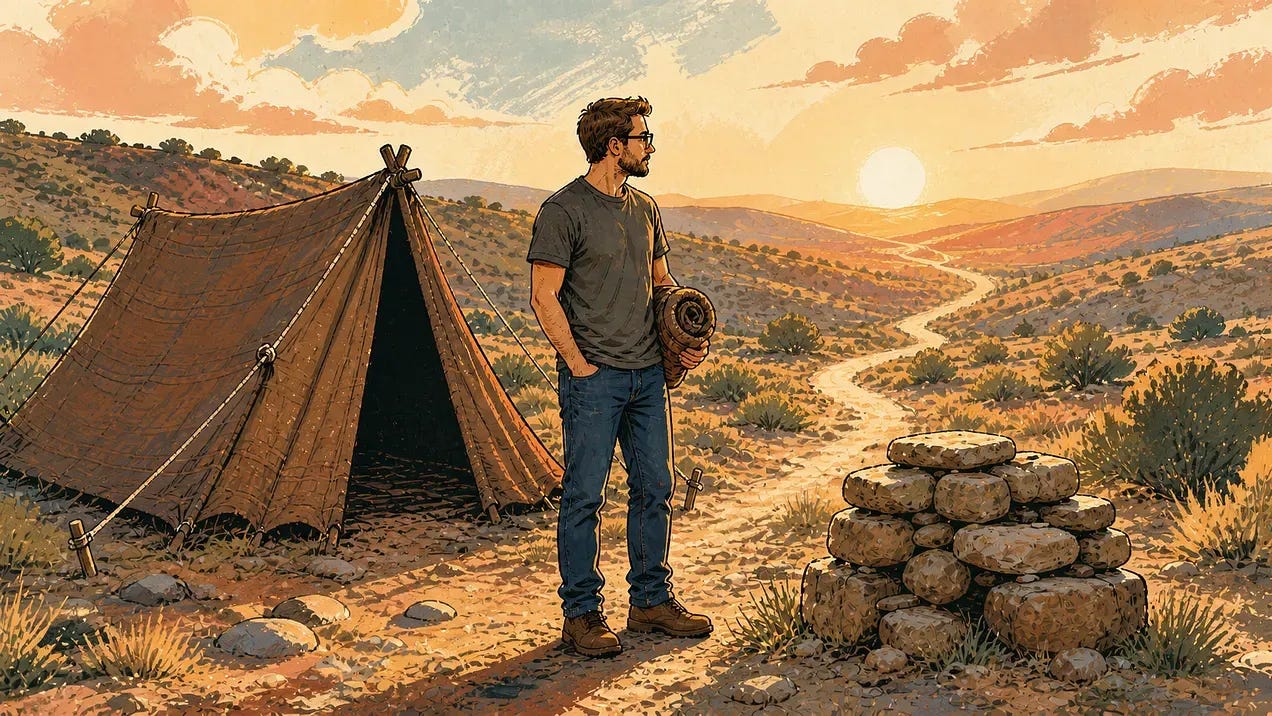
Two things keep appearing in Abraham’s story: tents and altars.
Abraham spent much of his life packing. He would settle somewhere, life would develop a rhythm, and eventually it was time to move again. The ropes came down, the animals were gathered, and the place that had been home became another place behind them.
But when Abraham arrived at Shechem, he built an altar. Near Bethel, he built another. When he returned from Egypt, he went back to an altar and called on the Lord. After Lot chose the Jordan Valley, Abraham moved again:
“So Abram moved his tent and came and settled by the oaks of Mamre, which are at Hebron, and there he built an altar to the LORD.” (Genesis 13:18)
The tent kept moving. The altar kept appearing.
I have had plenty of tents in my life. Jobs changed. Ministry changed. Relationships changed. Plans changed. Places that felt permanent became memories surprisingly quickly.
Some things are tents. We are not meant to keep them forever. But wherever we land, we can still open Scripture, pray, worship, gather with people who love Jesus, and remember what God has done.
Those practices may not change our circumstances or tell us when the next chapter will begin. They remind us who God is while we are here.
Abraham could not control every place the journey took him, but he could build an altar when he arrived.
Do Not Punish Today for What Has Not Happened Yet
Waiting can steal our lives in another way: it can make us feel guilty for enjoying them.
I have seen this in grief. Someone laughs around a table, then suddenly remembers the person they love is gone. Their expression changes, as if enjoying the moment means they are not grieving enough.
We can do something similar when an important part of life remains unresolved. How can I enjoy this season when my marriage is struggling? How can I celebrate when my prayer is still unanswered? We keep disappointment close, almost as if worrying proves how much it matters.
But disappointment does not require our constant attention. There are still meals worth enjoying, people worth laughing with, birthdays worth celebrating, and sunsets worth stopping for.
Abraham waited twenty-five years for Isaac. Surely not every day was miserable. There were meals around the fire, conversations, beautiful mornings, and evenings when everyone sat around longer than usual.
Isaac was not there. That mattered. But his absence did not make everything else meaningless.
You can be disappointed and grateful. You can wait and laugh. You can pray for tomorrow and thank God for today.
You do not dishonor what you are waiting for by enjoying what God has already given you.
What Is Already in Your Hands?
Abraham did not have Isaac, but he was not empty-handed. He had Sarah, a household, responsibilities, resources, influence, a calling, a relationship with God, and another morning each time he opened his eyes.
Sometimes the thing we are missing becomes so important that we stop noticing what is already in our hands. We stare at the empty chair and miss everyone else at the table.
Who is already sitting at your table? What responsibility has God entrusted to you? Who could you encourage? What opportunity have you ignored because it was not the opportunity you wanted? What would obedience look like if nothing changed this week?
For years, I believed the important part of my calling was ahead of me. Someday I would preach. Meanwhile, there were already people to encourage, Scripture to study, and small opportunities to serve. They simply did not look like the opportunity I was waiting for.
Maybe faithfulness is not waiting for your life to begin. Maybe it is giving God the life that is already happening.
How Do I Keep Living While I Wait?
“Trust God” is true. But after years of waiting, we may need to know what trust looks like on a Tuesday afternoon. Start with four questions.
What am I postponing?
Finish the sentence, “I will do that when…” Then ask whether it actually needs to wait. Some things do. Others have simply become attached to a future version of your life. Maybe you can call the friend, begin writing, serve somewhere, have people over, or enjoy this season now.
What am I clutching?
Where has uncertainty made you controlling or desperate? What are you afraid will happen if you open your hands? Sometimes our grip tells us more about our fear than our circumstances do.
What is already in my hands?
Name the people, responsibilities, opportunities, gifts, resources, and ordinary good things you have stopped noticing. You may not have what you asked God for, but that does not mean you have nothing.
Where can I build an altar?
Choose one simple rhythm that helps you remember God is present here too. Open your Bible before your phone. Take a walk and pray. Protect a Sabbath. Meet with someone who helps you remember what is true.
Nothing heroic. Just something that says:
God, I am still here. And I know You are too.
The Ordinary Tuesdays
When we think about Abraham’s wait, we remember the big moments: leaving home, receiving the promise, looking at the stars, and finally holding Isaac.
But most of those twenty-five years were ordinary. Abraham woke up. Someone prepared breakfast. Animals needed attention. There were conversations, problems, meals, work, sunrises, sunsets, and thousands of days Scripture never records.
I wonder how much of Abraham’s life with God happened on those days.
Maybe nothing you are waiting for will happen today. The phone may not ring. The door may not open. The relationship may not change. The answer may not come.
But today is still your life.
There are people to love, work to do, meals to enjoy, and altars to build. Abraham’s waiting years were not simply something to survive before his life began. They were his life too.
And these days are yours.
Do not miss the life God has given you while you are waiting for the life you have asked Him for.
Support Faith Unplugged
Waiting can make us so focused on what hasn’t happened yet that we miss the life God has already given us. If Faith Unplugged helps you notice God in the ordinary days and live faithfully while you wait, consider subscribing. Your support helps me continue writing reflections like this each week.

The amount of waiting on the LORD was historically a long time. It grew in them a hope in the LORDs faithfulness to his promises long before they were given a law to follow. The commands were simple and specific to each of them.
Beautiful article.
“Do not miss the life God has given you while you are waiting for the life you have asked Him for”. Such powerful words!! A great reminder for me in what often feels like a “never ending waiting season”. I keep trusting Him, praying about EVERYTHING as I continue living my life. I definitely know the meaning of patience. 🤣 I wouldn’t change any of it because I’m not writing my story, God is. 🙏 😊